
Sidella costruisce un vocabolario che parla la lingua del dato senza mai ricorrere al byte, una data-painting ante litteram
Nel lavoro di Giordano Sidella la pittura non è mai solo colore. È struttura e sistema. Una grammatica che sembra nascere prima della mano ci porta verso una solarità gioviale e rilassata, come se lo sguardo dell’artista scorresse su una matrice invisibile e benevola; un reticolo matematico che organizza la superficie prima ancora che il pennello la tocchi.
Sidella, nato a Bari nel 1962, autodidatta rigoroso, impermeabile alle mode digitali, costruisce un vocabolario che parla la lingua del dato senza mai ricorrere al byte. La sua è una data-painting ante litteram: non ci sono algoritmi, non ci sono software, non ci sono NFT, eppure tutto sembra funzionare come un’equazione.
L’unità minima dove nasce il dato pittorico
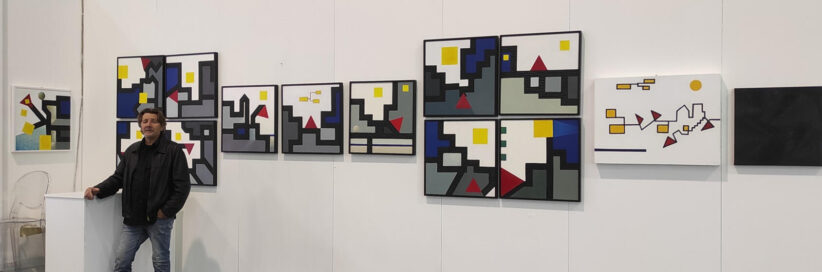
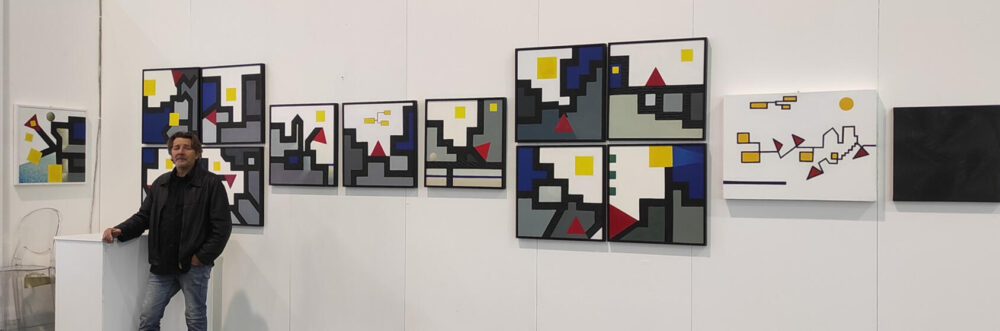
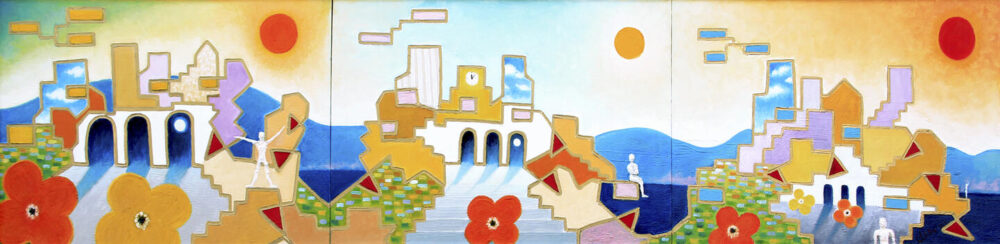
Nel suo percorso la nozione di “unità minima della linea” ha il valore di un postulato. Quadrati, triangoli, segmenti, micro-tracciati ripetuti con rigore modulare rappresentano passioni, slanci di energia e regole oppure leggi ineludibili che diventano cellule visive (i quadrati). Come se l’artista giocasse con i pixel, ma senza alcun contatto con la pixel art o la crypto art.
La differenza è decisiva: in Sidella il pixel non è digitale, non è un’icona pop, non è un ammiccamento. Il suo “pixellato” nasce da un’operazione primordiale ed esattamente opposta: dalla riduzione manuale, quasi ascetica, del gesto pittorico a una forma elementare ripetuta, moltiplicata, estesa sul campo pittorico fino a diventare tessuto, territorio, mappa.
È pittura che funziona come un foglio di calcolo, ma è ancora corpo. È matematica, ma autenticamente umana.
Frattali che si ribellano al computer
Nelle sequenze di forme che compongono le serie più recenti come Piani, Axon e Segni di Terra emerge un principio che è sì frattale frattale: ogni micro-modulo partecipa della struttura complessiva, ogni forma ripete la logica del tutto in scala ridotta.
È un procedimento intuitivo, non calcolato: Sidella non genera frattali tramite software, li incontra attraverso la pratica quotidiana, quasi per necessità interna della forma.
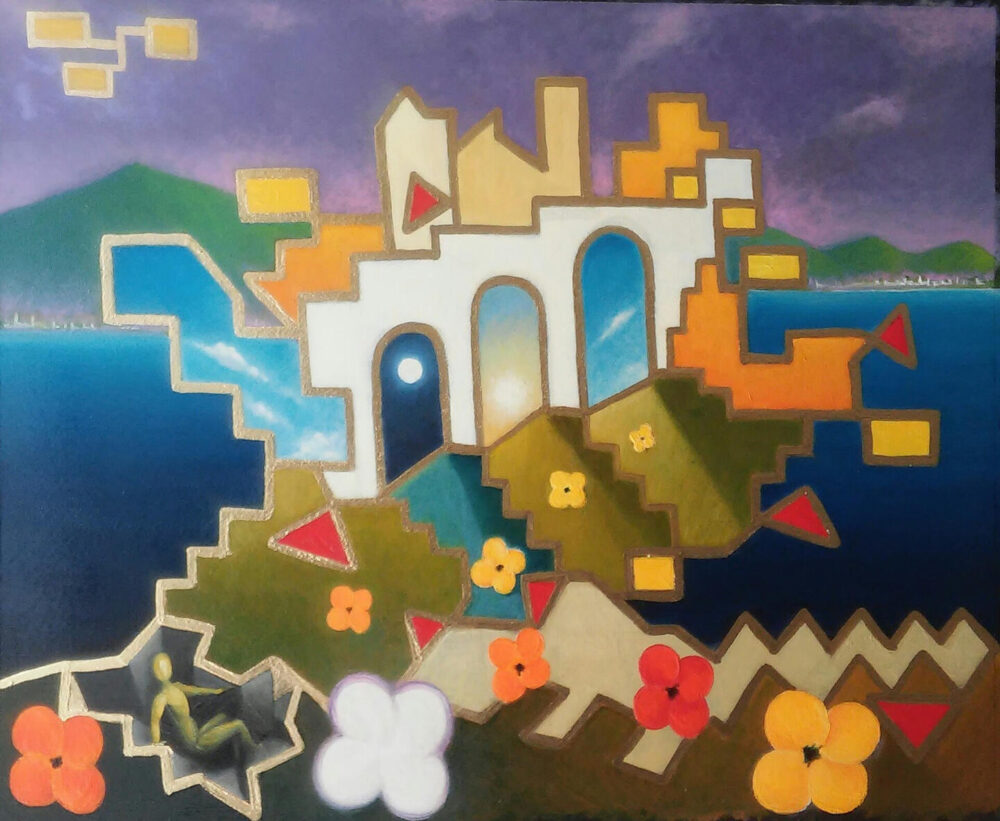
Il risultato vede la tela comportarsi come un ecosistema matematico che cresce per iterazione, ma senza rinunciare all’imperfezione viva del gesto. È una matematica non Euclidea, organica. Una geometria da respirare.
La logica della perfezione prima del racconto imperfetto
Molti artisti utilizzano la geometria per astrarre. Sidella, invece, utilizza il dato per costruire ed entrare in un’avventura. Il quadro non rappresenta qualcosa: accade come conseguenza di una procedura. Ogni opera è il risultato di una regola interna, non dichiarata ma evidente: un sistema di iterazioni, variazioni minime, contrasti, simmetrie rotte. Come le esperienze di una vita.
Qui nasce il suo carattere “data”:il dato come unità minima, come ritmo, come fondazione dell’immagine. Il dato come memoria del gesto
In questo senso Sidella appartiene più alla genealogia dei linguaggi sistemici (da Agnes Martin a Mario Nigro) che a quella della criptoarte. Non c’è il computer, ma il pensiero strutturale.
Autonomia radicale dal digitale
In un’epoca in cui ogni struttura modulare viene automaticamente associata al digitale, Sidella compie una scelta controcorrente. Non simula il linguaggio delle macchine e non sfrutta il vocabolario del metaverso.
La sua pittura arriva al pixellato per conto proprio, per evoluzione interna, come se la storia dell’immagine (dal mosaico al pattern islamico, dalla miniatura medievale, al mandala, alla serialità contemporanea) trovasse un punto di sintesi nel segno elementare ripetuto.
È per questo che il suo lavoro è prezioso nella prospettiva della Data Art: perché dimostra che la “cultura del dato” non è proprietà esclusiva del digitale. Può esistere come intuizione manuale, come disciplina della forma, come costruzione autopoietica dell’immagine. E poi la sequenza di Leonardo Fibonacci in fondo cosa insegna se non la perfezione matematica della natura?
Giordano Sidella lavora come se il quadro fosse un organismo generato da iterazioni minime, da cellule geometriche che replicano la loro logica nello spazio.
La sua pittura è un sistema complesso, ma non computazionale; un algoritmo, ma lasciato alla mano; un pattern vivo e vivace.
È questo paradosso, cioè una matematica calda, come una geometria sentimentale, a rendere il suo lavoro un esempio interessante di dato che si organizza, cresce, muta, senza perdere il contatto con l’umano che lo genera.
***
Giordano Sidella: painting as the sunlit discovery of new worlds
In Giordano Sidella’s work, painting is never just color. It is structure and system. A grammar that seems to arise before the hand moves leads us toward a jovial, relaxed luminosity, as if the artist’s gaze were sliding across an invisible and benevolent matrix — a mathematical lattice that organizes the surface even before the brush touches it.
Sidella, born in Bari in 1962, a rigorous autodidact, impermeable to digital trends, builds a vocabulary that speaks the language of data without ever resorting to the byte. His is a data-painting ante litteram: no algorithms, no software, no NFTs, and yet everything seems to function like an equation.
The minimal unit: where the pictorial datum is born
Along his path, the notion of the “minimal unit of the line” has the force of a postulate. Squares, triangles, segments, micro-traces repeated with modular rigor represent passions, bursts of energy, rules or inescapable laws that become visual cells (the squares). As if the artist were playing with pixels, though without any contact with pixel art or crypto art.
The difference is decisive: in Sidella, the pixel is not digital, not a pop icon, not a wink. His “pixellated” quality is born from a primordial and entirely opposite operation: the manual, almost ascetic reduction of the pictorial gesture into an elementary form that is repeated, multiplied, extended across the pictorial field until it becomes fabric, territory, map.
It is painting that functions like a spreadsheet, yet is still bodily. It is mathematics, but authentically human.
Fractals that rebel against the computer
In the sequences of forms composing his most recent series — Piani, Axon, Segni di Terra — a principle emerges that is indeed fractal: each micro-module participates in the overall structure, each form repeats the logic of the whole at a reduced scale.
It is an intuitive, not a calculated process: Sidella does not generate fractals through software; he encounters them through daily practice, almost out of an internal necessity of the form.
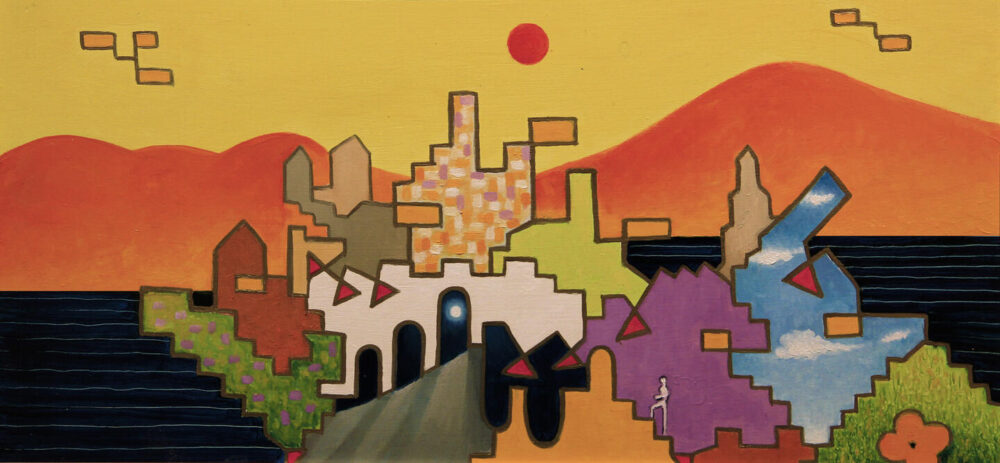
The result is a canvas that behaves like a mathematical ecosystem growing through iteration, yet without renouncing the living imperfection of the gesture. It is a non-Euclidean, organic mathematics. A geometry to be breathed.
Painting as data: logic before narrative
Many artists use geometry to abstract. Sidella, on the other hand, uses data to construct and to enter an adventure.
The painting does not represent something: it happens as the consequence of a procedure. Each work is the result of an internal rule, undeclared but evident: a system of iterations, minimal variations, contrasts, broken symmetries. Like the experiences of a life.
Here his “data” nature is born: data as minimal unit, as rhythm, as foundation of the image, as memory of the gesture.
In this sense, Sidella belongs more to the genealogy of systemic languages (from Agnes Martin to Mario Nigro) than to that of crypto art. There is no computer — only structural thought.
Radical autonomy from the digital
In an era when every modular structure is automatically associated with the digital realm, Sidella makes a counter-choice. He does not simulate machine language and does not exploit the vocabulary of the metaverse.
His painting arrives at the pixellated on its own, through internal evolution, as if the history of the image — from mosaic to Islamic pattern, from medieval miniature to mandala to contemporary seriality — found a point of synthesis in the repeated elementary sign.
This is why his work is valuable from a Data Art perspective: because it demonstrates that the “culture of data” is not the exclusive property of the digital. It can exist as manual intuition, as discipline of form, as the autopoietic construction of the image.
And after all, what does Leonardo Fibonacci’s sequence teach if not the mathematical perfection of nature?
Giordano Sidella works as though the canvas were an organism generated by minimal iterations, by geometric cells that replicate their logic across space.
His painting is a complex system, but not a computational one; an algorithm, but entrusted to the hand; a pattern that is alive and lively.
It is this paradox — a warm mathematics, a kind of sentimental geometry — that makes his work an intriguing example of data that organizes itself, grows, transforms, without losing contact with the human who generates it.