
L’artista digitale italiano Dangiuz annuncia un progetto che accompagna l’intera vita dell’artista, registrato sulla blockchain
Nel dibattito contemporaneo sull’arte digitale, il tempo non è più soltanto un contenitore: diventa materia prima, struttura narrativa, responsabilità etica. Là dove il mercato ha accelerato ogni gesto creativo fino a consumarlo, alcuni artisti scelgono di rallentare, non per nostalgia, ma per restituire all’opera una traiettoria esistenziale. The Oathkeepers di Dangiuz si inscrive esattamente qui: un progetto che fonde promessa, archivio e mortalità, e che usa la tecnologia non come feticcio, bensì come forma di testimonianza pubblica. In un’epoca che archivia le immagini più velocemente di quanto le sappia guardare, l’artista propone un patto: creare meno, creare meglio, creare nel tempo.
L’artista digitale italiano Dangiuz, noto per le sue immagini cyberpunk immersive e per la sua critica costante ai temi della sorveglianza, della tecnocrazia e del potere sistemico, ha annunciato The Oathkeepers, un progetto che ripensa il concetto di eredità artistica come un impegno che accompagna l’intera vita dell’artista, registrato sulla blockchain.
Negli ultimi dieci anni, Dangiuz è diventato una figura centrale nel panorama dell’arte digitale, con opere collezionate su importanti piattaforme e da istituzioni internazionali. Parallelamente, l’arte digitale è passata da una posizione marginale a una presenza sempre più riconosciuta nel discorso artistico contemporaneo. In questo contesto, l’introduzione della booth di Zero Ten (0x) ad Art Basel, Miami Beach, ha rappresentato un momento significativo. Zero Ten, che ha messo in luce artisti come Beeple e Jack Butcher, è stato ampiamente considerato un segnale forte della rilevanza culturale e di mercato dell’arte digitale, soprattutto in un periodo in cui il mondo NFT viene spesso dato per superato. Il successo di queste presentazioni ha rafforzato l’idea che l’arte nativa digitale non sia una moda passeggera, ma un linguaggio ancora in piena evoluzione.
The Oathkeepers è stato presentato il 31 dicembre 2025 con la prima opera, “Know your Limits”, e si fonda su una promessa semplice ma radicale. Dangiuz realizzerà una nuova opera ogni anno, rivelandola il 31 dicembre di ogni anno successivo, partito nel 2025, per tutto il tempo in cui sarà fisicamente in grado di creare arte. Non esiste una data di conclusione prestabilita. Il progetto terminerà solo quando l’artista decederà o non potrà più produrre nuove opere.
Ogni opera annuale verrà mintata attraverso uno smart contract dedicato chiamato Oathkeepers. Il numero di edizioni di ciascun lavoro corrisponderà al totale delle opere 1/1 mintate da Dangiuz nel corso della sua carriera. Queste edizioni verranno distribuite tramite airdrop a tutti i collezionisti che possiedono un 1/1 di Dangiuz, creando un legame diretto tra il lavoro passato dell’artista e la sua produzione futura.
In questa struttura, il concetto di possesso diventa qualcosa che si sviluppa nel tempo, piuttosto che un singolo atto di acquisizione. I collezionisti non si limitano a detenere un’opera, ma partecipano a un processo continuo, ricevendo nuovi lavori finché l’artista continuerà a rispettare il suo giuramento. Con il passare degli anni, il progetto darà forma a un archivio vivente che cresce insieme all’artista.
Le idee alla base di The Oathkeepers riflettono da vicino i temi che hanno definito la pratica di Dangiuz fin dall’inizio. In un contesto in cui gran parte del mondo dell’arte digitale ha privilegiato velocità, innovazione costante e novità tecnologica, questo progetto mette al centro continuità, misura e intenzionalità. Parallelamente, la produzione di opere separate continuerà, ma le Oathkeepers continueranno a nascere una volta l’anno. In questo caso, la blockchain non viene utilizzata come strumento di speculazione o di scala, ma come mezzo per rendere formale un impegno. Lo smart contract funziona come una registrazione pubblica di responsabilità, garantendo che la promessa non resti solo simbolica, ma venga rispettata nel tempo.
Al centro del progetto c’è anche un riconoscimento chiaro dei limiti umani. The Oathkeepers è legato alla durata della vita dell’artista, e ogni uscita annuale segna non solo una nuova opera, ma anche un altro anno vissuto. In questo senso, il tempo e la mortalità diventano parte integrante dell’opera stessa.
In un momento in cui l’arte digitale è spesso influenzata dall’automazione, dalla produzione rapida e da cicli di attenzione sempre più brevi, The Oathkeepers propone un approccio diverso. Non nasce per inseguire le tendenze o una rilevanza immediata, ma per esistere nel tempo. Come performance a lungo termine, archivio in evoluzione e patto condiviso tra artista e collezionisti, il progetto suggerisce un modo più lento e consapevole di pensare a ciò che l’arte digitale può essere.
“The Oathkeepers”: quando la blockchain diventa un testamento morale
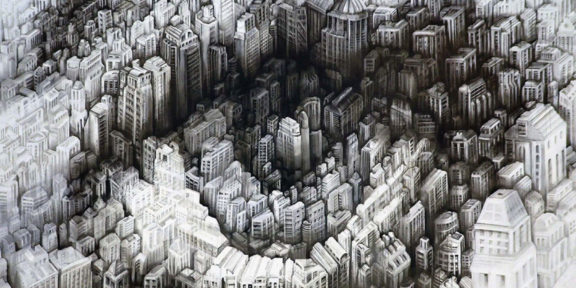
Dangiuz lavora da anni su un’immaginazione urbana che oscilla tra fascinazione tecnologica e inquietudine sistemica. Le sue città-labirinto sono schermi, specchi, altari: luoghi in cui l’umanità esiste come presenza fragile, spesso periferica, schiacciata dalla luce dei display e dal peso delle infrastrutture. The Oathkeepers non è solo l’estensione logica di questa poetica, ma il suo ribaltamento: il fulcro non è più l’oppressione del sistema, bensì la dignità del tempo umano.
La promessa di un’opera all’anno, fino a quando il corpo lo consentirà, trasforma la blockchain in un diario notarile dell’esistenza. Lo smart contract diventa un documento etico: non è una leva speculativa, ma un dispositivo di memoria. Ogni rilascio annuale non celebra la produttività, bensì il passaggio del tempo, con tutto ciò che comporta in fatto di fragilità, scarsità.
C’è, in questa scelta, un gesto profondamente controcorrente. Nel contesto dell’arte digitale, abituata a vivere sulla velocità delle piattaforme, sulla volatilità degli hype e sulla retorica del “nuovo a tutti i costi”, The Oathkeepers introduce lentezza programmata. I collezionisti non acquistano soltanto un’opera: contraggono una relazione nel tempo, diventano custodi di un processo. Il possesso non coincide più con il momento dell’acquisto, ma con l’adesione a una storia che cresce, invecchia, muta.
Così l’eredità artistica smette di essere retrospezione e diventa atto in divenire. Non è il catalogo finale a fare l’artista, ma la traiettoria, registrata, verificabile, condivisa. Dangiuz, che spesso ha descritto architetture del controllo, utilizza qui la stessa infrastruttura per restituire trasparenza, continuità e responsabilità: un paradosso fertile, quasi una riconversione poetica della tecnologia.
Knowyourlimits: dentro l’opera di Dangiuz
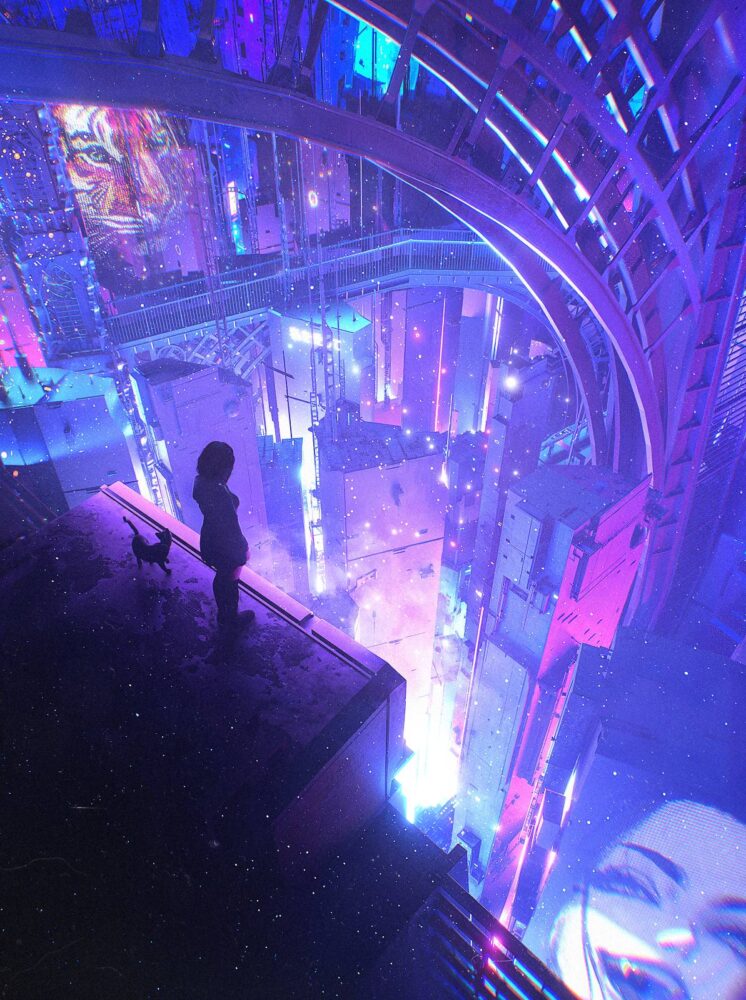
Una figura solitaria e un gatto affacciati sul precipizio luminoso di una metropoli stratificata, è una sintesi visiva della poetica di Dangiuz. La scena trattiene una tensione ambivalente: da un lato la promessa vertiginosa del futuro, dall’altro la percezione di trovarsi sempre un passo prima del baratro.
Le architetture si arricciano in curve che ricordano orbite o gusci protettivi, ma la loro scala è disumana. Le superfici brillano di un neon che seduce e insieme respinge; le proiezioni dei volti, giganteschi e intangibili, suggeriscono una presenza costante che osserva e governa. L’unico elemento veramente vivo è minuscolo: la silhouette dell’essere umano, accompagnato da un animale domestico, ambasciatore unico della natura, fragile avamposto di intimità in un universo automatizzato.
Questa composizione lavora su due livelli. Il primo è spettacolare, quasi cinematografico: invita lo sguardo a perdersi nei dettagli dell’abisso urbano. Il secondo è meditativo: quel vuoto acceso in fondo non è soltanto spazio architettonico, ma metafora del tempo che scorre, un’energia che attira, consuma, trasforma. Guardare “giù” equivale a contemplare il proprio passaggio in un sistema più grande e indifferente.
In relazione al progetto totalizzante di The Oathkeepers, l’opera assume un significato ulteriore: la promessa annuale dell’artista è il gesto di chi decide di restare sulla soglia, continuando a guardare e a testimoniare, senza farsi assorbire dalla velocità del sistema. Non una resa, ma un atto di cura: verso l’immagine, verso i collezionisti, verso il tempo stesso.
—
Dangiuz’s “Oathkeepers”: a literal lifetime commitment to art on blockchain
In the contemporary debate on digital art, time is no longer just a container: it becomes raw material, narrative structure, ethical responsibility. Where the market has accelerated every creative gesture to the point of consuming it, some artists choose to slow down, not out of nostalgia, but to return to the artwork an existential trajectory. Dangiuz’s The Oathkeepers positions itself precisely here: a project that fuses promise, archive, and mortality, using technology not as a fetish, but as a form of public testimony. In an era that files images away faster than it knows how to truly look at them, the artist proposes a pact: create less, create better, create over time.
Italian digital artist Dangiuz, known for his immersive cyberpunk imagery and his long- standing critique of surveillance, technocracy, and systemic power, has announced The Oathkeepers, a project that reframes artistic legacy as a lifelong commitment recorded on the blockchain.
Over the past decade, Dangiuz has become a central figure in the digital art space, with works collected across major platforms and institutions.
As digital art has moved from the margins toward broader recognition, moments like Art Basel Miami Beach’s introduction of the Zero Ten (0x) booth have played a key role in that shift. Zero Ten, which spotlighted artists such as Beeple and Jack Butcher, was widely seen as a strong signal of digital art’s cultural and market relevance, particularly at a time when the NFT space is often described as having lost momentum. The success of those presentations reinforced the idea that digital-native art is not a passing phenomenon, but a medium still actively defining itself.
The Oathkeepers was revealed on December 31, 2025, with the first artwork “Know your Limits”, and is built around a simple promise. Dangiuz will create one new artwork every year, releasing it on December 31 of each successive year, started in 2025, for as long as he is physically able to continue making art. There is no planned endpoint. The project concludes only when the artist deceases or can no longer produce new work.
Each annual piece will be minted through a dedicated Oathkeepers smart contract. The number of editions for each work will match the total number of 1/1 artworks Dangiuz has minted over his career. These editions will be distributed via airdrop to all existing Dangiuz 1/1 collectors, directly linking the artist’s past body of work to his future output.
In this structure, ownership becomes something that unfolds over time rather than a single moment of acquisition. Collectors are not simply holding an artwork, but participating in an ongoing process, receiving new pieces as long as the artist continues to honor the oath. Over the years, the project will form a living archive that grows alongside the artist himself.
The ideas behind The Oathkeepers closely reflect the themes that have shaped Dangiuz’s practice from the beginning. While much of the digital art world has focused on speed, constant innovation, and technological novelty, this project emphasizes continuity, restraint, and intention. Production of other works will continue, ma but the Oathkeepers will be born only once a year. Here, the blockchain is not used as a tool for speculation or scale, but as a way to formalize commitment. The smart contract functions as a public record of accountability, ensuring that the promise is not symbolic alone but structurally upheld.
There is also a clear acknowledgment of human limits at the core of the project. The Oathkeepers is bound to the artist’s lifespan, and each annual release marks not only a new work, but another year lived. In that sense, the project treats time and mortality as integral parts of the artwork itself.
At a moment when digital art is often shaped by automation, rapid production, and fleeting attention, The Oathkeepers offers a different approach. It is not designed to chase trends or short-term relevance, but to exist steadily over time. As a long-term performance, an evolving archive, and a shared commitment between artist and collectors, the project proposes a slower and more deliberate way of thinking about what digital art can be.
“The Oathkeepers”: when the blockchain becomes a moral testament
For years, Dangiuz has been working on an urban imagination that oscillates between technological fascination and systemic unease. His labyrinth-cities are screens, mirrors, altars: places where humanity exists as a fragile, often marginal presence, crushed by the glow of displays and the weight of infrastructure. The Oathkeepers is not only the logical extension of this poetics, but its reversal: the focus is no longer the oppression of the system, but the dignity of human time.
The promise of one work per year, for as long as the body allows, turns the blockchain into a notarial diary of existence. The smart contract becomes an ethical document: not a speculative lever, but a device of memory. Each annual release does not celebrate productivity, but the passage of time — with everything this entails in terms of fragility and scarcity.
There is, in this choice, a deeply counter-current gesture. In the context of digital art, accustomed to living on the speed of platforms, the volatility of hype, and the rhetoric of “new at all costs”, The Oathkeepers introduces programmed slowness. Collectors do not simply acquire a work: they enter into a relationship over time, becoming custodians of a process. Ownership no longer coincides with the moment of purchase, but with adherence to a story that grows, ages, and changes.
Thus, artistic legacy ceases to be retrospection and becomes an act in motion. It is not the final catalogue that makes the artist, but the trajectory, recorded, verifiable, shared. Dangiuz, who has often described architectures of control, here uses the same infrastructure to return transparency, continuity, and responsibility: a fertile paradox, almost a poetic reconversion of technology.
Knowyourlimits inside Dangiuz’s work
A solitary figure and a cat overlooking the luminous chasm of a layered metropolis form a visual synthesis of Dangiuz’s poetics. The scene holds an ambivalent tension: on one side the dizzying promise of the future, on the other the sense of always standing one step before the abyss.
The architectures curl into shapes that recall orbits or protective shells, yet their scale is inhuman. Surfaces gleam with a neon that both seduces and repels; the projections of faces, gigantic and intangible, suggest a constant presence that watches and governs. The only truly living element is tiny: the silhouette of the human being, accompanied by a domestic animal, the lone ambassador of nature, a fragile outpost of intimacy in an automated universe.
This composition works on two levels. The first is spectacular, almost cinematic: it invites the gaze to get lost in the details of the urban abyss. The second is meditative: that glowing void in the distance is not merely architectural space, but a metaphor for passing time, an energy that attracts, consumes, transforms. Looking “down” is equivalent to contemplating one’s own passage within a larger, indifferent system.
In relation to the all-encompassing project of The Oathkeepers, the work takes on a further meaning: the artist’s annual promise is the gesture of someone who chooses to remain on the threshold, continuing to watch and bear witness without being absorbed by the speed of the system. Not a surrender, but an act of care, toward the image, toward the collectors, and toward time itself.